Saumil
Patel

Computational Scientist
Computational Science Division & Leadership Computing Facility
Argonne National Laboratory

Building high-order numerical methods and GPU-accelerated solvers for multi-physics simulations at exascale — from turbulent combustion in engines to blood flow in arteries.

Saumil Patel
12+
Years at
Argonne
15+
Peer-Reviewed
Publications
Speedup on Largest
ICE Simulation
3
GPU Architectures
NVIDIA · AMD · Intel

Research Vision

My research develops high-order numerical methods for multi-physics simulations at scales that were, until recently, impossible. Over twelve years at Argonne National Laboratory, I have built spectral-element and lattice Boltzmann solvers that run efficiently on tens of thousands of GPUs — from NVIDIA’s accelerators at the Argonne Leadership Computing Facility to the AMD-based Frontier exascale machine at Oak Ridge.

I work at the intersection of three frontiers: mathematically rigorous discretization, performance-portable GPU computing, and data-driven augmentation of classical solvers.

This means developing spectral-element and discontinuous Galerkin formulations with provable convergence properties, then engineering them for portable execution across heterogeneous architectures using CUDA, SYCL, HIP, and Kokkos. Most recently, I have been augmenting these solvers with graph neural networks for mesh-based super-resolution — enabling large-scale parametric studies that would otherwise require prohibitive compute time.

The applications span internal combustion engine design, where our simulations delivered a four-fold speedup on the largest-ever ICE flow calculation, to hemodynamic modeling for clinical decision support and conjugate heat transfer in next-generation energy systems. I am increasingly focused on how in-situ visualization and machine learning can transform these simulations from post-hoc analysis tools into real-time predictive instruments.
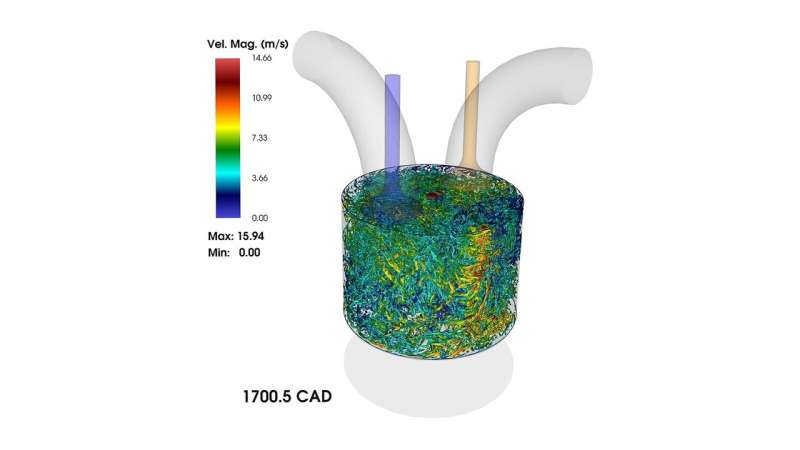
Largest-ever simulation of flow inside an internal combustion engine, conducted at Argonne National Laboratory
Figure 1. The largest-ever simulation of flow inside an internal combustion engine, conducted at Argonne National Laboratory. Spectral-element algorithms developed by Saumil for NekRS enabled a four-fold speedup in time-to-solution for this billion-element simulation, revealing cyclic variability mechanisms critical to next-generation engine design.

Background

Education

PhD, Mechanical Engineering
City College of New York
2010 – 2016
MA, Applied Mathematics
Cornell University
2007 – 2010
BA, Mathematics & Economics
Hunter College
2001 – 2003

Recognition

HPCwire Readers’ Choice Award
Best Use of HPC in Energy
ISAV 2023 Best Paper Award
In Situ Visualization of NekRS using SENSEI, at SC23

Areas of Expertise

Computational Fluid Dynamics Nek5000 / NekRS Spectral Elements Lattice Boltzmann Methods ALE / Moving Domains CUDA SYCL HIP Kokkos Exascale HPC Graph Neural Networks In-Situ Visualization Conjugate Heat Transfer ICE Simulation Hemodynamics

Selected Publications

2025
Mesh-based super-resolution of fluid flows with multiscale graph neural networks
S. Barwey, A. Pal, S. Patel, et al. — Computer Methods in Applied Mechanics and Engineering
A flux bounce-back scheme for the filtered spectral element lattice Boltzmann method
G. Zhao, S. Patel, Y. Lin, J. Lee — arXiv preprint
Scalable and consistent graph neural networks for distributed mesh-based data-driven modeling
S. Barwey, et al., S. PatelPeer-reviewed
2024
Large eddy simulation of gasoline and ethanol direct-injection compression-ignition sprays using the high-order spectral element method
J.D. Colmenares, M. Ameen, S. PatelJournal of Engineering for Gas Turbines and Power
2023
Performance evaluation of heterogeneous GPU programming frameworks for hemodynamic simulations
H. Liu, S. Patel, S. Rizzi, V. Mateevitsi, J. Insley — SC ’23 Workshops
Scaling computational fluid dynamics: In situ visualization of NekRS using SENSEI
V. Mateevitsi, N. Ferrier, P. Fischer, J. Insley, G.K. Lan, M. Min, T. Papka, S. Patel, S. Rizzi, et al. — ISAV 2023 at SC23
Best Paper Award
2022
Investigating the origins of cyclic variability in internal combustion engines using wall-resolved LES
Y. Wu, S. Patel, M. Ameen — Journal of Engineering for Gas Turbines and Power
Investigation of cycle-to-cycle variations in internal combustion engines using proper orthogonal decomposition
Y. Wu, S. Patel, M. Ameen — Flow, Turbulence and Combustion
Towards improved mesh-designing techniques for spark-ignition engines via spectral element methods
M. Chatterjee, M. Ameen, S. Patel
IMEXLBM 1.0: A proxy application based on the lattice Boltzmann method for computational fluid dynamics on GPUs
H. Liu, S. Patel, S. Balakrishnan, J. Lee — arXiv preprint
2019
A characteristic-based spectral element method for moving-domain problems
S. Patel, P. Fischer, M. Min, A. Tomboulides — Journal of Scientific Computing, 79, 564–592
2014–16
Recent developments in spectral element simulations of moving-domain problems
S. Patel, et al. — Springer Book Chapter
A spectral-element discontinuous Galerkin thermal lattice Boltzmann method for conjugate heat transfer
S. Patel, M. Min, J. Lee — ANL Technical Report
A spectral-element discontinuous Galerkin lattice Boltzmann method for simulating natural convection heat transfer in a horizontal concentric annulus
S. Patel, M. Min, K. Uga, J. Lee — Computers & Fluids, 95, 197–209

Research Directions

Physics-Informed Neural Surrogates for Spectral-Element Lattice Boltzmann Methods

I am developing graph neural network surrogates that embed collision-streaming physics directly into the network architecture, trained on spectral-element LBM simulation data. This work combines my SE-DG-LBM solver, the IMEXLBM proxy application, and recent multiscale GNN research to create surrogates that run parametric sweeps orders of magnitude faster while preserving conservation laws.

Foundation

Builds on the SE-DG-LBM solver (2014–15), IMEXLBM proxy app (2022), flux bounce-back scheme (2025), and multiscale GNN work (2025). Training data from natural convection annulus simulations; IMEXLBM enables fast GPU-based generation across parameter sweeps.

Significance

First surrogate model for SE-LBM on unstructured meshes. First to embed moment-space conservation and Chapman-Enskog consistency into GNN layers — combining deep expertise in both spectral-element lattice Boltzmann methods and distributed GNN-based surrogate modeling.

Click to expand

Exascale Wall-Resolved LES of Hydrogen Direct-Injection Engines

With the automotive industry’s pivot to hydrogen, I am extending my proven ICE simulation framework to model hydrogen direct-injection combustion at wall-resolved fidelity. The thin H₂ flame front is uniquely suited to spectral-element discretization, and DOE’s prioritization of hydrogen energy aligns with available exascale computing allocations on Aurora.

Foundation

Builds on the ICE portfolio (2022 cyclic variability, 2024 spray dynamics), ALE/moving-domain work (2016, 2019), POD methodology, and the NekRS solver with ALE framework, ICE meshing strategies, and ALCF computing allocations.

Significance

Wall-resolved LES of hydrogen ICE is essentially unexplored at scale. Thin H₂ flame fronts are uniquely suited to spectral elements. Hydrogen engines are a top DOE priority, Aurora is online, and the tools, allocations, and track record are in place.

Click to expand

In-Situ Visualization as Active Computational Steering

Building on the SENSEI-NekRS coupling framework recognized with the ISAV 2023 Best Paper Award, I am developing methods to transform in-situ visualization from passive monitoring into active computational steering. In hemodynamic simulations, real-time wall shear stress maps could automatically trigger spectral-element p-refinement where it matters clinically.

Foundation

Builds on the SENSEI-NekRS coupling (ISAV 2023 Best Paper), GPU hemodynamic solver (SC23), spectral element p-refinement capability, and performance models from the SC23 benchmarking paper.

Significance

In-situ visualization has always been passive observation; this makes it an active steering mechanism. Directly clinically relevant — clinicians care about localized WSS at the aneurysm neck, and p-refinement targets exactly that without GPU load-balancing nightmares.

Click to expand

Distributed GNN Digital Twins for Electric Vehicle Thermal Management

Applying the same conjugate heat transfer physics from my doctoral work to a new domain, I am investigating how distributed graph neural networks can enable real-time thermal management digital twins for electric vehicle motor cooling — predicting full thermal fields from sparse thermocouple data without resolution loss.

Foundation

Builds on conjugate heat transfer expertise (SE-LBM, 2015), distributed GNN scaling, mesh super-resolution (2025), and GPU computing capabilities. Same physics, new geometry — the distributed GNN framework and multiscale architecture carry directly.

Significance

GNN preserves the full spatial field on the actual mesh with no POD-ROM resolution loss and handles complex geometries without retraining. The EV transition is the defining industrial shift, and DOE electrification priorities align with Argonne’s automotive portfolio.

Click to expand

Cross-Architecture Performance Portability of Filtered SE-LBM

Leveraging my experience porting solvers across NVIDIA, AMD, and Intel GPU architectures, I am conducting systematic benchmarks of the filtered spectral-element LBM across Frontier, Polaris, and Aurora. This would be the first cross-architecture study of any SE-LBM variant — ever.

Foundation

Builds on the IMEXLBM proxy app (2022), flux bounce-back implementation (2025), multi-framework benchmarking methodology (SC23 hemodynamics paper), and ALCF machine allocations across all three vendors.

Significance

SE-LBM has fundamentally different GPU characteristics than standard LBM: high arithmetic intensity collision, memory-bound streaming, and filtering. Never studied cross-architecture. This is the fastest-track direction — a benchmarking study with existing codes that can proceed in parallel with longer-term projects.

Click to expand

Get in Touch

I am exploring opportunities in computational science, HPC engineering, and faculty positions in the greater Philadelphia area, beginning Fall 2026. I welcome conversations about research collaboration, open positions, or shared interests in high-performance scientific computing.